
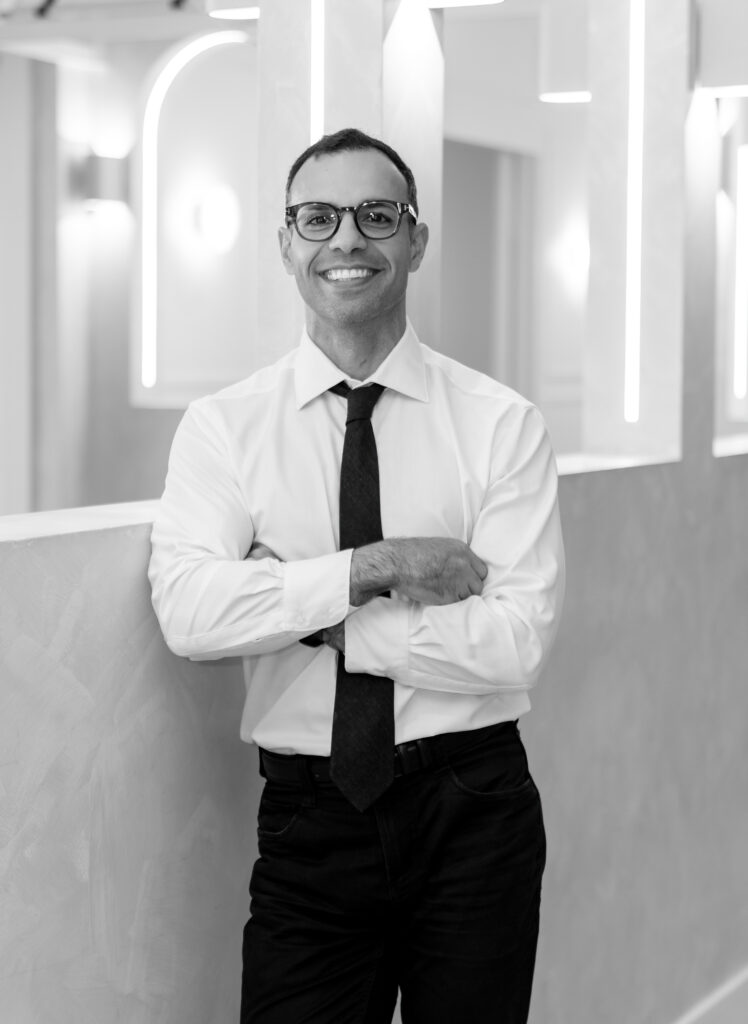
By Bruce Khajehnoori, Regional Director NSW, IA
A 2-part series on my lived experience of thinking and learning differently, by Bruce Khajehnoori.
I wasn’t officially diagnosed with ADHD until my mid-twenties. It was only later that I began to understand the role dyslexia had also played throughout my education.
Ironically, the child who struggled to learn within traditional environments would eventually build a career designing them.
For much of my school life, I assumed the problem was me.
Looking back, learning was difficult.
Not occasionally difficult.
Consistently difficult.
I watched classmates grasp concepts that seemed obvious while I struggled to understand what teachers were explaining. Reading took more effort. Following instructions sometimes felt overwhelming. Tasks that appeared straightforward for others often felt frustratingly complex.
Years later, I began to ask a different question.
What if some of the challenge wasn’t individual capability?
What if part of the challenge was the environment itself?
Today, as a designer, I find myself returning to that question regularly.
Throughout my career, I’ve worked on workplaces, educational facilities, government environments and public spaces.
That question becomes even more important when we consider one of design’s most persistent assumptions: the idea of an average user. The average employee, student, customer or visitor may be a useful abstraction, but they do not exist in real life. Every person brings different experiences, preferences, strengths, challenges and ways of thinking. If our environments are designed around an imagined average, many real people are required to work harder simply to participate.
One observation continues to stand out.
People experience the same environment very differently.
Some thrive in busy settings.
Others perform better in quieter spaces.
Some process information best through discussion.
Others need time to reflect independently.
Some gain energy from constant interaction.
Others lose it.
Yet many environments continue to be designed around an assumption that people work, learn and engage in broadly the same way.
Historically, we’ve often designed around expectations such as:
The challenge is that very few people fit that model perfectly.
My experience of learning differently taught me something that has influenced my entire approach to design.
Attention and understanding do not exist in isolation.
They’re influenced by environment.
Factors such as:
can significantly influence how people focus, process information and perform.
I’ve seen this play out repeatedly during stakeholder engagement sessions.
People rarely ask for larger spaces.
More commonly, they ask for:
Whether we’re talking about a student, an employee or a visitor, the underlying need is remarkably similar.
People want environments that support the way they work best.
Importantly, these responses are not specialist accommodations that benefit only a small group. Better acoustics improve concentration for everyone. Clear wayfinding reduces uncertainty. Flexible settings support different working styles. Retreat spaces give people somewhere to reset. Designing with neurodiversity in mind is not a separate layer added to good design; it is one way of achieving good design.
Designing for the edges often improves outcomes for the middle. The goal is not to create one perfect environment, but to create environments flexible enough to support different ways of thinking.
The more I reflect on my own experiences, the less convinced I become that there is a normal way to learn, work or engage with the world. Once we accept that there is no average user, we can stop asking people to adapt to our environments and start creating environments that adapt to people.
Perhaps the better question is this:
As designers, clients, educators and leaders, what would change if we treated human difference as our starting point rather than an exception?
Part 2: Choice Matters: Designing Better Learning Environments for Different Minds

Bruce Khajehnoori
Regional Director NSW, IA